
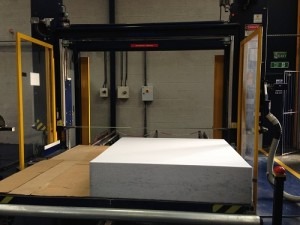
Every industry that relies on foam eventually runs into the same wall: the standard sheet, roll, or block on the shelf simply doesn’t fit the job at hand. Maybe it’s a radiator tucked into an awkward corner of a construction vehicle, or an engine room on a yacht that needs precise thermal control without adding excess weight. This is the point where raw material stops being useful on its own and needs the hand of a skilled foam converter to become something purpose-built. This article explores foam conversion not just as a manufacturing step, but as a problem-solving discipline — one that turns a generic block of material into an engineered answer to a very specific challenge.
1. Defining the Problem Foam Conversion Solves
Foam, in its raw state, is deliberately generic. A supplier produces it in standard thicknesses and densities because that’s efficient at scale. But almost no real-world application calls for a generic block. A vehicle cabin needs foam shaped around brackets and wiring. A packaging line needs cavities cut to the exact dimensions of a fragile product. A soundproofing project needs panels profiled to trap specific frequency ranges.
Foam conversion is the bridge between the generic and the specific. It’s the set of processes — cutting, moulding, laminating, and fabricating — that reshapes ordinary polyurethane, polystyrene, or polyethylene foam into something engineered for one job and one job only. Without this step, foam remains raw potential rather than a working solution.
2. The Toolkit of a Skilled Foam Converter
Solving these problems requires more than a single machine. A capable foam converter typically works with a full production arsenal:
- Band saws, for fast, high-volume straight cuts
- Profiled slitters and standard slitters, for shaping sheets to precise thickness and contour
- CNC profiling machines, for programmable, repeatable, intricate designs
- Laminators, for bonding foam to itself or to other materials
- Water jets, for clean cuts that avoid the heat distortion some foams are prone to
- Spray booths, for applying coatings and surface treatments
- Die cut presses, for high-precision shapes produced consistently at volume
It’s the combination of these tools — not any single one — that allows a converter to move a standard product into technical, application-specific territory. That range matters because no two problems look alike: sound absorption around a radiator calls for a different approach than thermal insulation in a marine engine room, even though both start with the same raw foam.
3. Matching Material to Application
Not all foam behaves the same way, and part of a converter’s expertise lies in knowing which type suits which job.
Polyurethane foam is the workhorse of cushioning — found in mattresses, seat padding, and protective packaging thanks to its comfort and resilience.
Polystyrene foam brings lightweight strength and strong thermal resistance, making it a natural fit for disposable containers, protective packaging, and insulation panels.
Polyethylene foam holds up against moisture and wear, so it tends to appear in padding, protective wrapping, and insulation where durability under repeated use is essential.
Choosing the wrong base material can undermine an otherwise well-executed conversion process, which is why experienced converters weigh application requirements before a single cut is made.
4. The Conversion Process, Step by Step
Cutting
Depending on precision and volume needs, foam can be shaped through hot wire cutting, water jet cutting, or die cutting — each suited to different tolerances and production speeds.
Moulding
Injection and compression moulding create consistent three-dimensional shapes, useful for products manufactured repeatedly at scale.
Laminating
Bonding foam layers together, or attaching foam to fabrics, films, or barrier materials, builds in properties the raw foam doesn’t have on its own — added density, improved fire resistance, or enhanced acoustic performance.
Fabrication
The final stage assembles converted foam components with other materials into a complete, installation-ready product.
5. Sectors That Depend on Foam Conversion
The reach of foam conversion extends well beyond any single industry:
- Packaging — custom-cut inserts that protect delicate goods in transit
- Furniture and Automotive Seating — shaped cushioning engineered for comfort and support
- Construction — thermal and acoustic insulation panels
- Medical and Healthcare — orthopaedic supports and positioning cushions built to precise clinical specifications
- Automotive Interiors — headrests, armrests, and cabin insulation
- Marine — engine room insulation balancing heat management with weight constraints
Each of these applications demonstrates the same underlying truth: raw foam only becomes valuable once a foam converter has shaped it around a real-world constraint.
6. Benefits of Partnering With an Experienced Foam Converter
- Custom-fit solutions — components engineered for a specific space, load, or acoustic requirement rather than a generic average
- Cross-sector problem-solving — a converter who has worked across construction, marine, automotive, and medical sectors brings a wider range of tested solutions to new challenges
- Consistent quality — rigorous quality control ensures every batch meets both industry standards and the customer’s specific brief
- Reduced waste — precise cutting techniques and, increasingly, recycled or eco-friendly foam stock help minimise environmental impact
- Faster problem resolution — access to multiple processes under one roof (cutting, laminating, moulding, fabrication) means fewer handoffs and quicker turnaround
- Long-term reliability — components built to spec reduce the risk of premature failure, rework, or costly redesigns down the line
7. Quality Control: Where Conversion Earns Trust
Converted foam frequently ends up in applications where failure isn’t an option — vehicle interiors, marine environments, and medical settings among them. That’s why reputable converters build quality control into every stage of production, checking dimensions, density, and performance against both industry standards and the customer’s original specification before anything ships. This attention to detail is what separates a genuine foam converter from a supplier simply cutting material to rough size.
8. Sustainability as Part of the Conversion Process
As environmental expectations rise across manufacturing, foam conversion has responded. Offcuts are increasingly reprocessed rather than discarded, recycled foam stock is more widely available, and cutting methods have become more efficient at minimising material waste. Businesses selecting a foam converter today often weigh environmental practices alongside technical capability — and the two are no longer mutually exclusive.
Conclusion
Foam conversion is what turns a shelf-standard block of material into a precisely engineered solution — whether that means absorbing sound around a radiator, insulating an engine room, or cushioning a medical device. The process depends on the right combination of machinery, material knowledge, and quality control, applied by a foam converter who treats every project as its own unique specification rather than a one-size-fits-all product. For any business facing a problem that generic foam can’t solve, that expertise is often exactly what closes the gap between a rough idea and a finished, reliable component.